

5 things we learned from Audley’s event Delivering Change in Government with Sir Nick Gibb
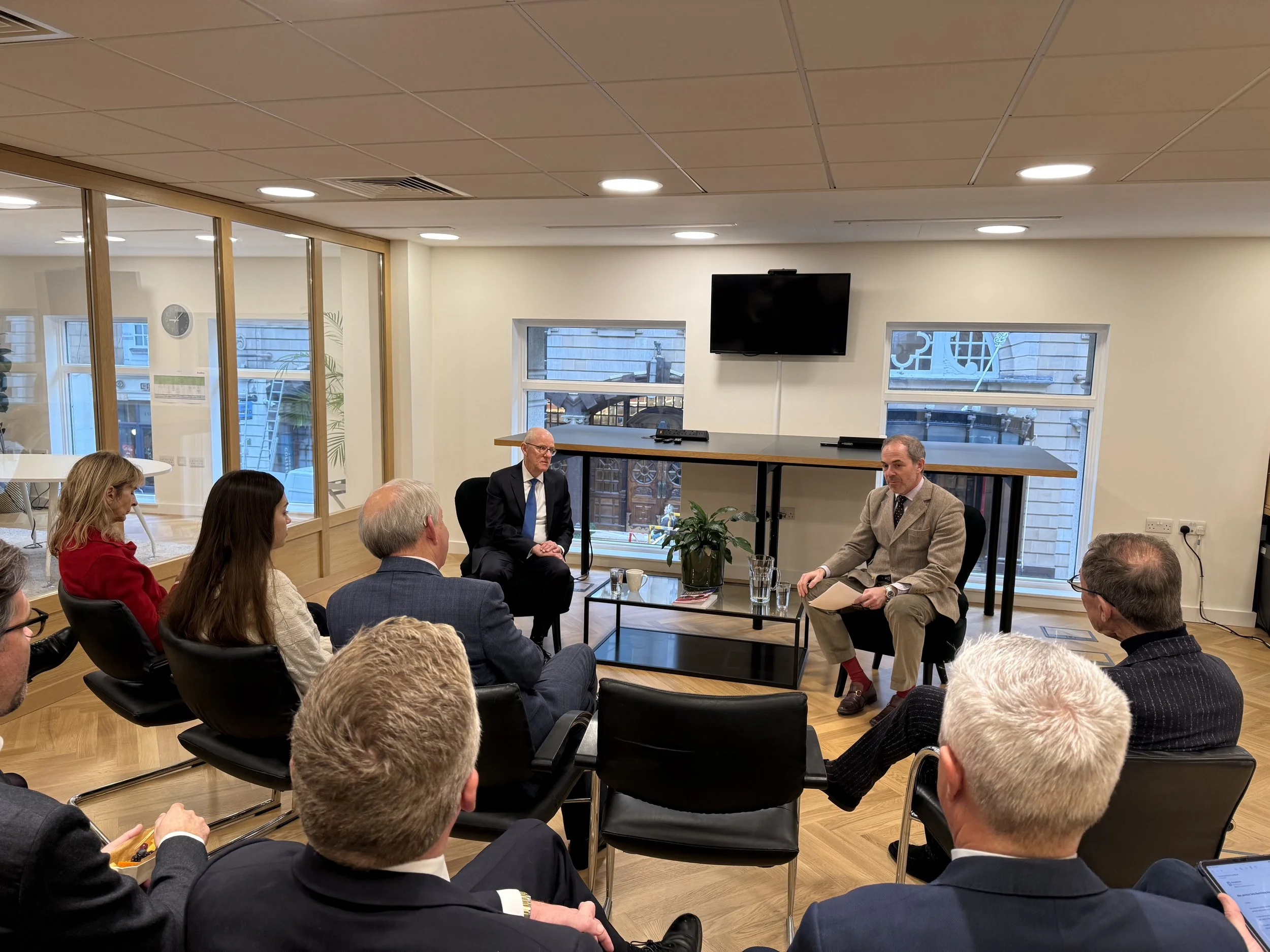
5 things we learned from Audley’s event with Sir Nick Gibb, former MP and Schools Minister, about how he drove his and Michael Gove’s landmark educational reforms and why it is so difficult for government to get things done.
The views expressed by Sir Nick Gibb are his own, and do not represent those of Audley.
Why do governments promise transformation yet struggle to deliver? Is this failure born of limited ambition, or too much of it? What does it really take to overcome the barriers to meaningful reform in modern government?
On Thursday 27 November, Audley hosted a breakfast event with former MP and Schools Minister Sir Nick Gibb, who has recently joined Audley as a Senior Advisor. Nick explored these questions in conversation with Principal Advisor Harry Wynne-Williams.
During the course of their conversation, we learned about Nick’s path into politics, why education matters to him, the ‘what’ and ‘how’ of his educational reforms, his views on the future of education, and where governments go wrong. Here are our 5 key lessons from the event:
1. Why Enter Politics?
When asked what inspired him to begin his 27-year political career, Nick explained that, in a word, it was “Ideas.”
He was eager to be on the front line in the battle of ideas. Originally it was his strong views about the economy and the importance of the free market; but later, following his election to Parliament in 1997, he moved his focus from economics to education.
His own education took him from England, to Canada, and back again. Nick cited poor behaviour and a “weak curriculum” as examples of where education began to go wrong in the latter half of the twentieth century, as well as an ideological approach that was failing too many children, particularly those from more challenging backgrounds.
His observations were borne out by international data on comparative declining standards in the UK’s schools from the year 2000 onwards, which would be published by the OECD. As Shadow Schools Minister between 2005 and 2010, he was determined to find the cause of the decline. In 2010, he became Minister of State for Schools in the Conservative-Liberal Democrat coalition government.
2. How Do You Deliver Change?
In 2000, the OECD issued its first international schools rankings as part of its Programme for International Student Assessment (PISA). While the UK was ranked 7th in the world in terms of reading performance and 8th in mathematics in 2000, by 2009 it had dropped to 25th and 28th respectively.
Nick told us he “spent every Monday visiting schools all over the country to try and find out why the UK’s school standards were declining.”
This was one of Nick’s key lessons: you must first identify the public policy problem you’re trying to solve and then understand its cause before embarking on policy prescriptions.
From his many conversations with teachers, head teachers and academics, together with his own reading, Nick identified the cause of the problems in our schools was an ideology he calls ‘progressivism.’
Nick described this ideology as a Romantic belief that children can learn without being filled with society’s knowledge. It’s an ideology that downplays the importance of bookish hard work and the role of teachers as the imparters of knowledge to their pupils. It espouses a belief in ‘learning by discovery’ or by inquiry rather than teacher-led instruction. It’s hostile to exams and memorisation.
This ideology was helpfully explained by the American academic E. D. Hirsch in his seminal book, The Schools We Need and Why We Don’t Have Them. Hirsch’s explanation and critique, Nick realised, applied equally to the UK.
Having found the root cause of the problem, Nick and Michael Gove embarked on a series of reforms to counter its influence, transforming the Primary National Curriculum, introducing the Phonics and Multiplication Checks, and revising GCSEs and A-Levels. By 2022, England (rather than the UK) had climbed the PISA rankings to be 13th for reading and 11th in maths. And in the PIRLS (Progress in International Reading Study) survey of the reading ability of 9-year-olds, England came fourth in world for countries that tested children of the same age.
3. AI and the Future of Education
While Nick sees the potential for uses of AI in education – to lighten teachers’ workload with certain tasks such as marking, data collection, and report writing, for example – he also fears that it could create a “generation leaving the education system who can’t think.”
Our critical thinking abilities depend on building knowledge in our long-term memory. In the age of AI, when it is possible for a young person to get the answers to any question in seconds, school pupils who use the technology to do the work of acquiring and analysing knowledge will lose out on developing key skills such as the ability to think critically, to solve problems, and creativity, all of which depend on having knowledge in long-term memory.
4. Why Can’t the Government Get Anything Done?
In light of its difficult first year-or-so in power, Harry asked Nick: what can the current government do to get better at getting things done?
Nick returned to his method for finding solutions to problems, which he said applied to all sectors, and not just education. You must first identify the problem you’re trying to solve in your particular sector; immerse yourself; meet people with views that challenge prevailing orthodoxies; learn; and then, from all of this will come the solutions and policies. He added that ideology is often at the root of failing or weak public sector delivery. He said that the current government gives the impression that they did none of this preparatory work during their years in opposition.
Nick also believes that politicians have in recent years failed to take themselves and policy development seriously. Politics has become a game participants play, dominated by gossip and factionalism. The media doesn’t help, he added, with its focus on division and the ephemera of politics rather than reporting the details of what is actually happening and the ideas that drive those developments.
This, said Nick, drives superficiality and a lack authenticity in mainstream politics. But for voters who seek authenticity in their politicians, if they fail to find it in the dominant centrist political parties, they will surely find it amongst those espousing extremist politics of both left and right. Centrist, mainstream parties that fail to deliver promised reform and improvements in public services and the economy, combined with a lack of sincerity and seriousness, are driving democratic politics around the world to the extremes and increasingly undermining people’s faith in democracy. As a consequence, Nick is pessimistic about global democratic politics.
Nick believes that to deal with this all of us – media, politicians, the electorate – need to start taking our conduct of politics more seriously, from the selection of political candidates to the reporting of political discourse. We need a more honest analysis of the problems and challenges facing our country.
5. On Compromise
Nick was asked how you negotiate compromise when trying to deliver reform in government. It’s inevitable that you will have to navigate competing interests and cede ground when you are trying to introduce radical changes in any sector, and your grand ambitions can be brought down to earth.
Nick, firm in his convictions, admitted that he hates compromise, and with reason regarding education. As he asked the room, if your goal is to close the attainment gap in education between disadvantaged and more advantaged children, ensuring better outcomes for more pupils, why would you compromise if it means fewer children do well?
However, Nick acknowledged that you are sometimes forced to compromise to ensure that some of the solutions you want to enact are realised. As he said, don’t compromise for the sake of having an easier life or avoiding being attacked on Twitter or in the papers, but be prepared to do so if the alternative to compromising is achieving nothing.